A party rental rain policy is a written rule, agreed before the customer pays, that says which weather cancels an outdoor rental, who makes that call, the deadline for making it, and what the customer gets. The policies customers accept split unsafe weather (your call, generous outcome) from merely wet weather (their call, deposit kept or turned into credit), and lock the decision before the first truck leaves. Below you get a decision table, a decision-night timeline, and complete policy wording you can paste into quotes and checkout.
Key takeaways
- Split the policy in two: you cancel for safety (lightning, wind over your unit's limit, flooding) and the customer gets a free reschedule or credit; they cancel for comfort and the deposit is kept or converted to credit.
- Never invent a wind number. Use the maximum in each unit's manufacturer manual; the CPSC's consumer guidance gives a range of 15 to 25 mph, not a single figure.
- Tie the decision deadline to dispatch, not to party start. A common cutoff is 6–8 p.m. the evening before delivery.
- Name one forecast source (the National Weather Service forecast for the event address) so nobody argues over which app was right.
- Publish the policy where customers see it before paying: product page, quote, checkout terms and confirmation.
What should a party rental rain policy include?
A rain policy covers outdoor gear (bounce houses, water slides, open tents, outdoor games) when weather stops a safe setup or safe use. "We'll see on the day" is not a policy. A policy answers six questions in writing:
- Which weather cancels? Separate light rain from lightning, high wind and standing water.
- Who decides? Safety cancels are your call; "we'd prefer a dry day" is the customer's.
- When is the call locked? At a fixed time before dispatch.
- Which forecast counts? One named source, checked at the deadline.
- What does the customer get? Reschedule, credit, substitute, partial or full refund, depending on who cancelled and when.
- What if weather turns after setup? Who stops play, and whether any money comes back.
If those answers live only in the owner's head, every storm becomes a negotiation, the same chaos as peak-weekend double bookings. Your rain policy also sits inside your wider rental cancellation policy: weather is one cancellation reason with its own rules, not a separate contract.
Rain or unsafe? Who decides, and what happens
Customers hear "rain" and think refund. Operators hear liability, wet vinyl and a crew stuck in mud. Two tiers shrink the argument:
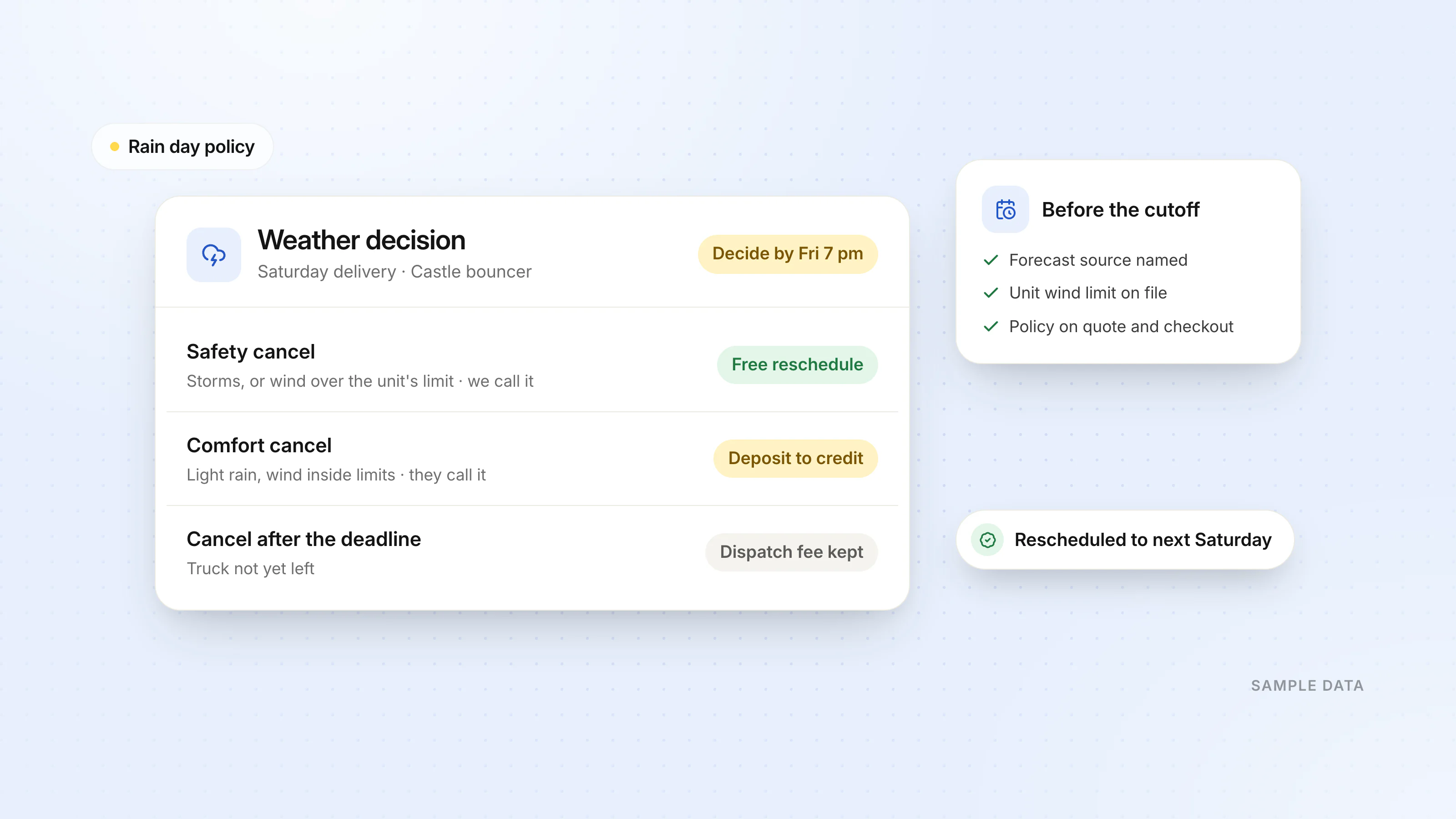
- Tier A, safety cancel (you call it). Conditions where you will not set up or will not let anyone use the equipment. You own the call because you own the risk, so the outcome is generous.
- Tier B, comfort cancel (they call it). The weather is inside your safety limits but the customer would rather not go ahead. They are buying flexibility on a date you held for them, so the outcome costs them something.
Use this table to set the outcome for each condition. Fill in your own limits where it says so.
| Condition at the decision deadline | Who decides | Tier | Customer outcome |
|---|---|---|---|
| Thunderstorms in the forecast for the event window | Operator | A | Free reschedule or full credit; full refund if you cannot offer a reasonable date |
| Sustained wind or gusts above the unit's manufacturer limit | Operator | A | Free reschedule, credit, or a covered substitute (indoor unit, tent with sidewalls) |
| Flooded or waterlogged setup area, or a severe weather warning from the NWS for the area | Operator | A | Free reschedule or full credit |
| Light rain forecast, wind inside limits | Customer | B | Reschedule if a date is open; otherwise deposit kept or converted to credit |
| Customer cancels for weather before the deadline | Customer | B | Your standard cancellation terms apply |
| Customer cancels after the deadline, truck not yet left | Customer | B | Deposit kept or credited; balance refunded minus a dispatch fee |
| Weather turns after the unit is set up and in use | Crew lead | Operator stop | Equipment stopped for safety; delivery fee kept; any partial credit is your choice, stated in advance |
| Your equipment fails or the crew cannot deliver | Operator | Operator fault | Full refund or free reschedule, the customer's choice |
What wind speed is too high for a bounce house?
The honest answer is: whatever the manufacturer of that unit says. Commercial inflatables in the US are built and operated under ASTM F2374, the standard practice for the design, manufacture, operation and maintenance of inflatable amusement devices, and each unit's operating limits come in its owner's manual. A small bouncer and a tall dry slide may not share one number.
The US Consumer Product Safety Commission's bounce house safety reminder (August 2019) says maximum wind speed should be no more than 15 to 25 mph, and to follow the manufacturer's setup instructions and stake the unit on a flat surface. That is a range for the public, not a substitute for your manual.
Find your own wind limit before you publish
Look up the maximum wind speed in the manual for every outdoor unit you rent, and write it on the unit's record. If a manual is missing, ask the manufacturer for it. Then check your insurer's conditions and your state's amusement ride or inflatable inspection rules, which can be stricter. Publish the lowest number that applies, and decide whether your rule uses sustained wind, gusts, or both. For tents, use the tent manufacturer's ratings and anchoring instructions, and any local permit conditions.
Lightning needs no number. The National Weather Service's rule is when thunder roars, go indoors, and its guidance for outdoor activities says to wait at least 30 minutes after the last thunder before resuming. Write both into the after-setup part of your policy so the crew lead has a rule to point to.
When should you make the weather call?
The expensive mistake is "call us by 10 a.m. on party day" when trucks leave at 6:30 a.m. By then routes are built, the crew is paid, and a cancel still burns the slot.
Tie the cutoff to dispatch, not to the party start time:
- Evening-before cutoff. A common cutoff is 6–8 p.m. the evening before delivery; earlier if your first wave leaves before sunrise.
- Hours before first dispatch. Some operators prefer a set number of hours before the first truck leaves, which adjusts itself on early days.
- One named forecast. Use the National Weather Service forecast for the event address (search by address or ZIP on weather.gov), checked at the deadline, and save a screenshot to the booking.
If you use a rain-chance trigger ("50% or higher"), know what the number means: the NWS defines probability of precipitation as the chance a point gets at least 0.01 inch of rain. It says nothing about how heavy or how long. For inflatables, wind and lightning are usually the better triggers; rain chance alone tends to cancel parties that would have gone fine.
What happens on decision night?
The policy only works if the same steps happen every time. This is a timeline for a Saturday delivery with a 7 p.m. cutoff; shift the times to match yours.
Decision-night timeline (Saturday delivery, 7 p.m. cutoff)
- Thursday evening: Check the extended forecast for every outdoor booking. Text at-risk customers: "We make the weather call at 7 p.m. Friday. You'll hear from us either way."
- Friday, 4 p.m.: Re-check the NWS forecast for each event address. For bookings likely to hit a Tier A condition, line up open dates and indoor substitutes.
- Friday, 7 p.m.: Make the call. Save the forecast screenshot to each affected booking, send Tier A customers their options in writing, and confirm everyone else.
- Friday, 7–9 p.m.: Release cancelled slots to inventory, rebuild routes and load lists, and tell the crew who is not going out (easier with a weekend staffing plan).
- Saturday, before dispatch: Final look at radar and wind. A new Tier A condition is still your safety call.
- Saturday, on site: Crew lead checks wind and lightning at setup and during the rental, stops use when the rule says so, and logs the time and reason.
- Monday: Process reschedules and credits, and log each weather call for next season.
What should customers get when the weather cancels a party?
A binary "full refund or nothing" policy trains refund demands and leaves trucks idle. Offer a short menu and price it so peak Saturdays stay valuable, the same scarcity logic as peak season rental pricing.
- Reschedule first. Best when the calendar has room. Set a window and write it down; hold the new date and release the old one.
- Covered substitute. An indoor unit, tent sidewalls or a canopy. Quote any price difference before you confirm.
- Store credit. For customers whose next free weekend is months away. State when it expires, and check your state's rules on credit expiry.
- Partial refund after the deadline. Customer cancels after the cutoff, truck not yet left: refund what they paid minus the deposit or a flat dispatch fee.
- Full refund. For Tier A cancels with no reasonable date, and for your own equipment or delivery failure.
Worked example. Say a combo bounce house rents for $250 with a $75 deposit, and the customer paid in full.
- Tier A, you cancel for wind and no date works: refund $250.
- Tier B, the customer cancels for light rain after the 7 p.m. cutoff, truck not yet left, with a $50 dispatch fee in your policy: refund $250 − $50 = $200.
- Tier B, same cancel, but your policy keeps the deposit as credit instead: refund $250 − $75 = $175 now, and $75 credit for a future date.
Whichever line you choose, the customer should be able to do this arithmetic from your published policy before they book.
Rain policy wording you can copy
Replace each bracket with your own numbers. The wind figure must come from your manufacturer, insurer or state rules, not from this page. This is a starting draft, not legal advice: have your attorney check it against your state's rules and your digital rental contract.
Weather and rain policy
Weather policy. Outdoor rentals, including inflatables, water slides, open tents and outdoor games, are set up only when it is safe to do so.
Weather we cancel for. We may delay, pause or cancel delivery if, at our decision deadline, the National Weather Service forecast for your event address shows thunderstorms, sustained winds or gusts above [X] mph (the lowest manufacturer limit for your items), or a severe weather warning, or if the setup area is flooded.
Decision deadline. We make the weather call at [7:00 p.m.] the evening before delivery and will contact you either way.
If we cancel for safety. You can reschedule within [N] days at no charge, take a full credit valid for [M] months, or accept a covered substitute where available. If we cannot offer a reasonable date, we will refund what you paid.
If you cancel for weather inside our limits. Before the deadline, our standard cancellation terms apply. After the deadline, your deposit of $[D] is [kept / converted to credit], and any balance you paid is refunded minus a $[Y] dispatch fee if our truck has not left.
Weather after setup. If thunder is heard or wind passes the equipment's limit during your rental, our crew or the person in charge must stop use immediately and keep everyone off the equipment until it is safe. Use may resume 30 minutes after the last thunder. Delivery and setup fees are not refunded once equipment is delivered and set up in safe conditions; [any partial credit we offer].
Where should the rain policy appear?
A policy the customer first sees after a dispute will be treated as optional. Put it in front of them before money moves, and make sure your crew can enforce it. On product pages, a two-line version is enough:
Weather policy. Outdoor inflatables are not set up in thunderstorms or in wind above the manufacturer's limit for the unit. We make the weather call at [7 p.m.] the evening before delivery and contact you either way.
Publish and train
- Product page of every outdoor item: one line on wind, lightning and the decision deadline.
- Quote or proposal email: the full policy, above the deposit line.
- Online checkout: a required terms box that includes the weather policy, as part of your online booking setup.
- Booking confirmation and the reminder sent a few days before the event: the deadline and how you will contact them.
- Rental agreement: the same text, signed with the rest of the contract.
- Crew briefing: who can authorize a Tier A cancel, how to log the forecast screenshot, and when to stop use on site.
After the season, check weather refunds against outdoor revenue and how many weather cancels became reschedules. If refunds climb while reschedules stay low, your menu is too binary or your deadline falls after trucks leave.
Build your rain policy with GRS
GRS has a free rain policy generator that turns the decisions in this guide into wording. Tick the equipment it covers, enter the wind limit from your own manufacturer or insurer (it never fills one in), choose an evening-before or hours-before-dispatch deadline, pick the outcomes for each kind of cancel, and copy the result into your quotes and terms.
Inside the platform, GRS online booking takes the deposit at checkout and sends the confirmation, so the policy is in front of customers before they pay. The party rental software keeps quotes, deposits and live inventory together, so a slot released on decision night shows as available again.